Welcome to AR-327 !!
Today's learning objectives:
- Understand the fundamentals of object-oriented programming
- Get familiar with classes
- Get confident in creating classes and objects
Object-Oriented Programming (OOP)
Object-Oriented Programming (OOP)
When programming, we often need to represent concepts that cannot be represented with a single integer, a string, or even a dictionnary. We need something that can represent those concepts in a structured and repeatable wayObject-Oriented Programming (OOP)
Example:
You need to represent a door in code. You have different heights, widths, depths, materials, handle heights, pivoting sides, ... but they are all doorsObject-Oriented Programming (OOP)
all doorsYou don't want to write custom code for every door
(remember, last course we saw function, which follow the same logic: every time you have a similar opration to perform: create a function)
⬇️
Hence the usage of classes
But what is a classe?
a Class is a code template to create objects. Objects have member attributes and have methods associated with them.But what is a classe?
a Class is a code template to create objects. Objects have member attributes and have methods associated with them.Let's take a look at an example !
Let's create a class for a timber beam
There are many types of timber beams possible: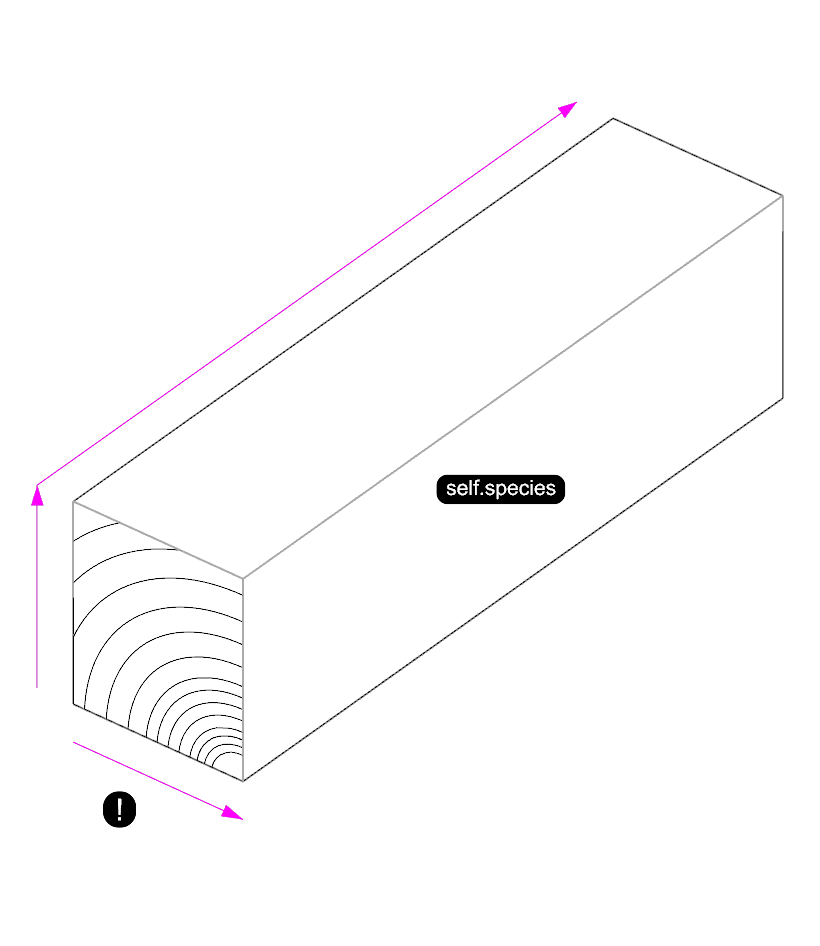
Solid timber beam
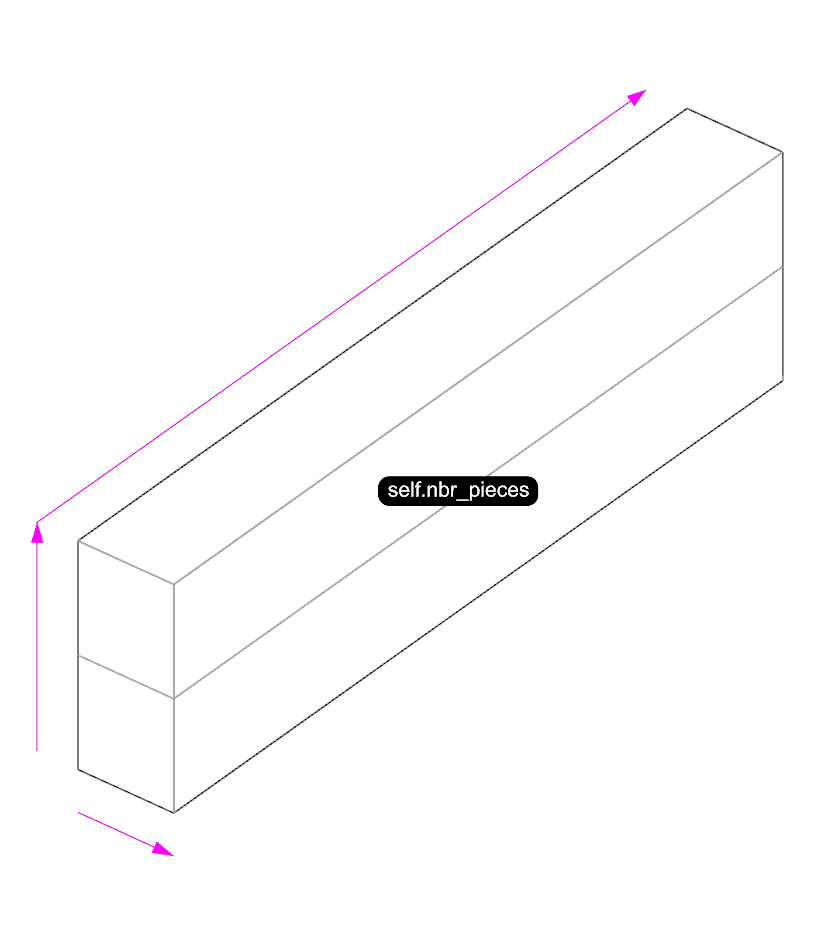
Duo beam
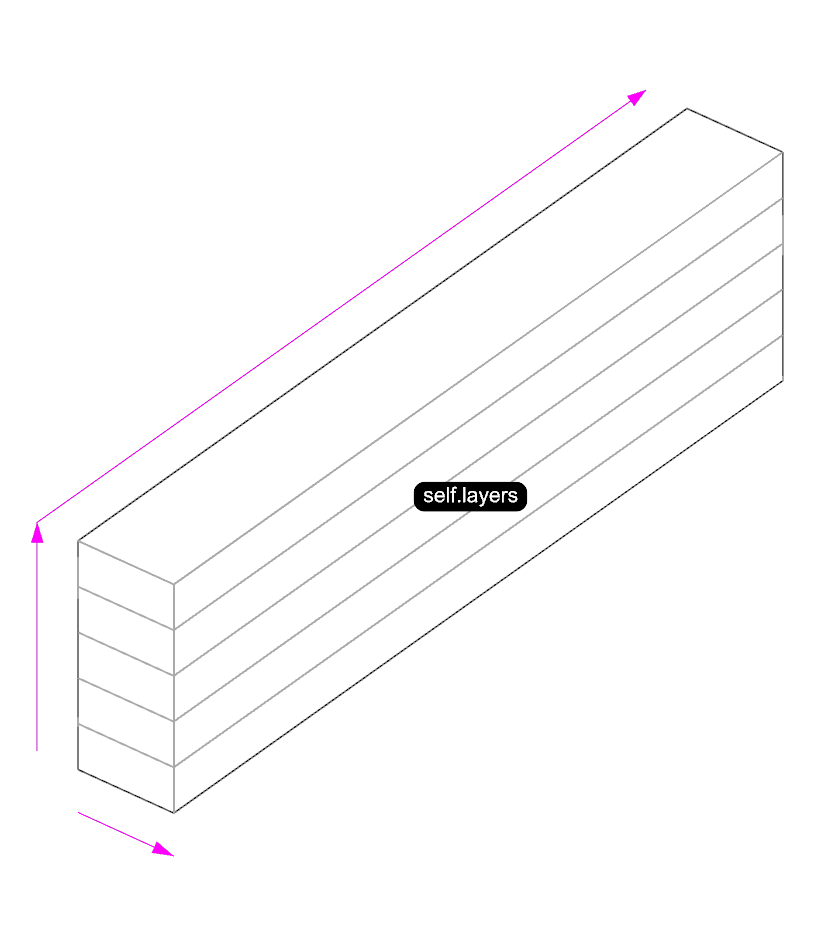
Gluelam beam
Let's create a class for a timber beam
There are many types of timber beams possible:
Solid timber beam
Duo beam
Gluelam beam
What defines a beam ? Let's discuss it together, and decide how we eill define our class
Let's create a class for a timber beam
Our class should contain:- The length of the beam
- The width of the beam
- The height of the beam
- The material of the beam
These are called attributes
Let's create a class for a timber beam
Our class should contain:- The length of the beam -> float
- The width of the beam -> float
- The height of the beam -> float
- The material of the beam -> string (for ex.)
These are called attributes
Let's create a class for a timber beam
            class Beam:
                # This is the constructor
                def __init__(self, length: float,
                                   width: float,
                                   height: float,
                                   material: str):
                    # These are the attributes:
                    self.length = length
                    self.width = width
                    self.height = height
                    self.material = material
Let's create a class for a timber beam
            class Beam:
                def __init__(self, length: float,
                                   width: float,
                                   height: float,
                                   material: str):
                    self.length = length
                    self.width = width
                    self.height = height
                    self.material = material
What is `self` ?
Let's create a class for a timber beam
            class Beam:
                def __init__(self, length: float,
                                   width: float,
                                   height: float,
                                   material: str):
                    self.length = length
                    self.width = width
                    self.height = height
                    self.material = material
`self` allows the function or constructor to access the class' attibutes and methods. It baysically says "hey, this method/constructor will need to access the internal data of the class "
Let's create and instanciate a class for a timber beam
            class Beam:
                def __init__(self, length: float,
                                   width: float,
                                   height: float,
                                   material: str):
                    self.length = length
                    self.width = width
                    self.height = height
                    self.material = material

            my_super_beam = Beam(3000, 80, 160, "duo")
            print(my_super_beam.height) # What will appear in the terminal ?
Let's create a class for a timber beam
But we can also embed functions in classes, called methodsLet's create a class for a timber beam
For example we can embed a function that calculates the volume of the beam:
            class Beam:
                def __init__(self, length: float,
                                   width: float,
                                   height: float,
                                   material: str):
                    self.length = length
                    self.width = width
                    self.height = height
                    self.material = material

                # This is a method
                def calculate_volume(self):
                    return(self.length * self.width * self.height)

            my_super_beam = Beam(3000, 80, 160, "duo")
            print(my_super_beam.calculate_volume()) # What will appear in the terminal ?
Let's instanciate multiple objects
            beam_a = Beam(4200, 120, 200, "gluelam")
            beam_b = Beam(3600, 120, 160, "duo")
            beam_c = Beam(3600, 120, 200, "gluelam")
            if beam_a.calculate_volume() > beam_b.calculate_volume():
                print("beam_a is bigger than beam_b")
            else:
                print("beam_b is bigger or as big as beam_a")
Now we have created three beams objects that all share the same attributes and methods
Small exercice on classes (20 min)
In the website, go to 04) Object-oriented programming and solve the first exerciceClass attributes
Class attributes
As seen in the previous section, attributes are variables stored "inside" a class.
Class attributes
As seen in the previous section, attributes are variables stored "inside" a class.In our beam example, the length, width, height and material are attributes of the class `Beam`
            class Beam:
                def __init__(self, length: float,
                                   width: float,
                                   height: float,
                                   material: str):
                    self.length = length
                    self.width = width
                    self.height = height
                    self.material = material
Class attributes
The attributes can be accessed and set like this:
            class Beam:
                def __init__(self, length: float,
                                   width: float,
                                   height: float,
                                   material: str):
                    self.length = length
                    self.width = width
                    self.height = height
                    self.material = material

            my_super_beam = Beam(4200, 120, 200, "gluelam")

            my_super_beam.length = 2200 # Retrieveing and changing the length from 4200 to 2200
Class methods
Class methods
A method is a function stored "inside" a class
Class methods
A method is a function stored "inside" a class
            class Beam:
                def __init__(self, length: float,
                                   width: float,
                                   height: float,
                                   material: str):
                    self.length = length
                    self.width = width
                    self.height = height
                    self.material = material

                def calculate_volume(self):
                    return(self.length * self.width * self.height)
Class methods
A method is a function stored "inside" a class Much like a function, you call a method
            class Beam:
                def __init__(self, length: float,
                                   width: float,
                                   height: float,
                                   material: str):
                    self.length = length
                    self.width = width
                    self.height = height
                    self.material = material

                def calculate_volume(self):
                    return(self.length * self.width * self.height)

            my_super_beam = Beam(3000, 80, 160, "duo")
            volume = my_super_beam.calculate_volume() # here we call the method
Small exercice on class methods (10 min)
In the website, go to 04) oop-methods and solve the first exercice
Assignment on Python OOP: